


Scaling adoption of energy efficiency technologies
Fund for Energy Efficiency Technologies (FEET)
In progress
Project overview
Timeline
Start November 2025
GCMD team members
Shane BALANI
Lead
Sipei HUANG
Wan Ni GOH
Zheng Yang CHENG
Victor PANG
Partners
AIM Horizon Investments
DBS Bank
Development Bank of Japan
ING Bank N.V., Singapore Branch
Stephenson Harwood
Watson Farley & Williams

Link copied to clipboard
Background
Energy efficiency is critical to reducing shipping emissions in the near term
Shipping carries around 80% of world trade by volume and accounts for close to 3% of global greenhouse gas emissions. With affordable zero-carbon fuels unlikely to be available at meaningful volumes this decade, energy efficiency technologies (EETs), such as wind-assisted propulsion systems (WAPS) and air lubrication systems (ALS), offer an immediate way to reduce fuel consumption and emissions.
Their role will become even more important as shipping transitions to new fuels. These fuels are expected to carry hefty premiums, face supply constraints and have lower energy densities than conventional fossil fuels. Using less fuel of any kind will therefore be increasingly important: not only to reduce costs and emissions, but also to reduce the volume of lower-energy-density fuels that vessels need to carry onboard.
Yet despite these benefits and the commercial availability of EETs, adoption remains limited.
Performance uncertainty and financing barriers constrain EET adoption
Fuel savings from EETs vary with weather, routing and vessel operations. Without standardised methodologies to quantify savings attributable to the EET, shipowners and charterers cannot reliably assess returns on investment.
This uncertainty exacerbates the split-incentive issue, where shipowners bear the cost of retrofits while charterers realise the fuel savings.
Financing presents another barrier. EET installations typically cost USD 3-5M, which may be too small for traditional ship mortgages. Shipowners therefore need access to unsecured financing, which can be difficult to obtain at an affordable cost.
FEET connects verified fuel savings with financing to accelerate EET adoption
To address these barriers, GCMD and AIM Horizon Investments established the Fund for Energy Efficiency Technologies (FEET), a first-of-its-kind blended finance fund that links payments directly to verified fuel and regulatory savings through a pay-as-you-save mechanism.
Relevant articles
Hear from the team
Beyond building the scientific foundation through real-world pilots, rigorous data analysis and robust methodologies for verifying fuel savings, we’ve also contributed to the development of an innovative blended financing structure that addresses the risks and commercial barriers that have historically held back investment in EETs. Developing a first-of-its-kind fund has not been straightforward, but the collective expertise and rigour of our partners have been instrumental in getting us here. With FEET now operational, we hope to demonstrate how innovative financing, underpinned by credible performance data, can unlock investment, diversify risks and enable the industry to deploy energy efficiency technologies at scale.”
Shane BALANI, Project Director, GCMD
As we deploy, as we get more projects under our belt, as more data comes in, as we are able to prove the product, we hope that FEET gets bigger, it gains more partners, and be able to attract more capital, we are able to solve problems that people feel that they have today. And we do it in a collaborate way, I think that would be the best way to move forward.
Rajbir TALWAR, Chief Investment Officer, AIM Horizon Investments
Overview of FEET
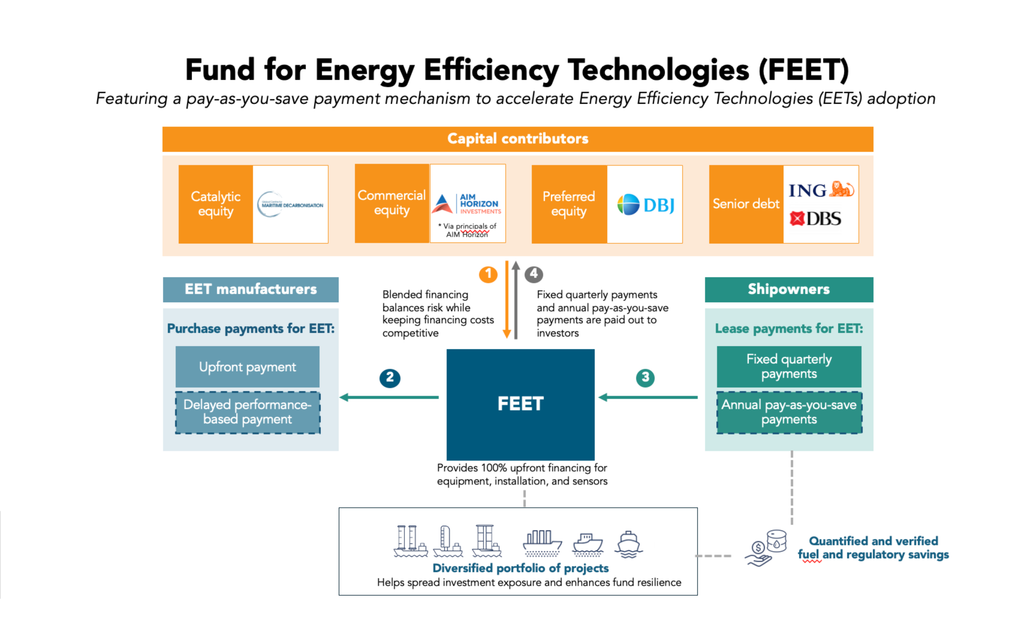
FEET is a first-of-its-kind blended finance fund designed to accelerate the adoption of EETs on ships. It uses a pay-as-you-save mechanism tied directly to verified fuel and regulatory savings generated by the technologies.
In doing so, this pay-as-you-save mechanism aligns the interests of shipowners, manufacturers, investors and lenders, enabling them to share performance risks and rewards.
FEET is managed by AIM Horizon Investments, with GCMD providing catalytic equity and acting as the fund’s decarbonisation advisor.
FEET provides up to 100% upfront unsecured financing for the EET project costs, decoupling EET financing from existing vessel mortgages. This reduces potential complications with ships’ existing financing arrangements.
GCMD’s EET performance pilots underpin the methodology used to quantify fuel savings, providing the technical basis for performance-linked payments.
With payment linked directly to quantified savings, FEET leverages a blended financing structure and invests in a diversified portfolio of projects to address commercial risks and align stakeholders.
FEET has secured commitments of up to USD 35M through a blended finance structure.
GCMD contributes catalytic equity and acts as the decarbonisation advisor, developing robust methodologies to measure performance and quantify fuel savings delivered by EETs.
AIM Horizon Investments manages the fund and its shareholders hold the commercial equity stake.
The Development Bank of Japan provides preferred equity, and banks including DBS Bank and ING have, in principle, agreed to provide senior debt, creating a blended structure that balances risk and helps keep overall financing costs competitive.
How FEET supports EET adoption
FEET focuses on EETs that can deliver measurable fuel and emissions savings. Its current focus is on wind-assisted propulsion systems (WAPS) and air lubrication systems (ALS).
Accurate measurement of fuel savings requires robust instrumentation. To support this, GCMD has conducted a series of EET performance pilots to quantify fuel savings with statistical confidence. We have installed high-frequency sensors and data collection systems to capture detailed vessel and EET operating parameters, including shaft power, fuel consumption, and navigational conditions.
On-off tests are one way to attribute performance to the EET. To ensure that measured differences in vessel performance are attributable to the retrofit, on-off transitions are extensively screened through our methodology to isolate performance only when operational and environmental parameters are stable.
Drawing on its EET performance pilots, GCMD has developed a methodology to quantify the fuel savings attributable to each retrofit while accounting for changes in operating conditions. FEET will use this methodology, reviewed by an independent third party, to underpin FEET’s pay-as-you-save mechanism.
For each project under FEET, the collected data will be audited and the calculated fuel savings independently verified. These verified savings will determine the performance-based component of shipowners’ lease payments.
There are several safeguards: high-frequency data collection using strict protocols; portfolio diversification across technologies and vessels; collaborative screening of trading patterns and age; and the use of four capital layers—catalytic equity, commercial equity, preferred equity, and senior debt—to balance risk and pricing.
GCMD acts as the decarbonisation advisor, stress testing scenarios on sailing routes, regulations, and fuel prices which would form the basis for determining the pay-as-you-save mechanism and calculating annual savings.
Where FEET is headed
FEET has made progress in recognition, deployment and the development of a robust basis for linking financing to verified performance.
The fund received Marine Money’s 2025 Wild Card East Deal of the Year award.
Read about the award win here.
FEET has also made its first deployment, financing two wind-assisted propulsion projects with Eastern Pacific Shipping.
Read the press release here.
In addition, FEET is the first fund to be aligned with the updated Singapore-Asia Taxonomy for Sustainable Finance. The methodology it uses to quantify fuel savings from EETs has also been independently reviewed by Lloyd’s Register.
FEET aims to make EETs more accessible by financing projects across different technologies, vessels, and shipowners. As its portfolio grows, it will build a broader base of performance data to support investment decisions and help reduce financing barriers.
With more than 300 ALS and over 100 WAPS installed across the global fleet to date, FEET aims to scale to USD 500M by 2030, which could fund around 200 projects, substantially increasing the number of EETs deployed.
The potential addressable market for WAPS and ALS installations is estimated at around USD 20B and we welcome other industry players and financing institutions to recognise the potential of energy efficiency and help close the funding gap.
Get in Touch

